|
cchawla [at] cs [dot] cmu [dot] edu
Hi! I'm a MS Robotics student at the Robotics Institute at Carnegie Mellon University, advised by Prof. Guanya Shi.
My research focuses on learning-based robotic manipulation. I aim to leverage human priors that bridge human and robot capabilities to build generalist agents. I work on developing physics-aware algorithms that leverage scalable human data sources, such as human–object interaction datasets and large-scale internet videos, to teach robots robust, executable skills. Previously, I completed my Bachelor's from T.U. Munich, where I was a 4-time recipient of the
German National Scholarship,
along with the Heinrich and Lotte Muhlfenzl Scholarship and the
TUM Promos Scholarship. CV / Google Scholar / Github / LinkedIn |

|
Research |
|
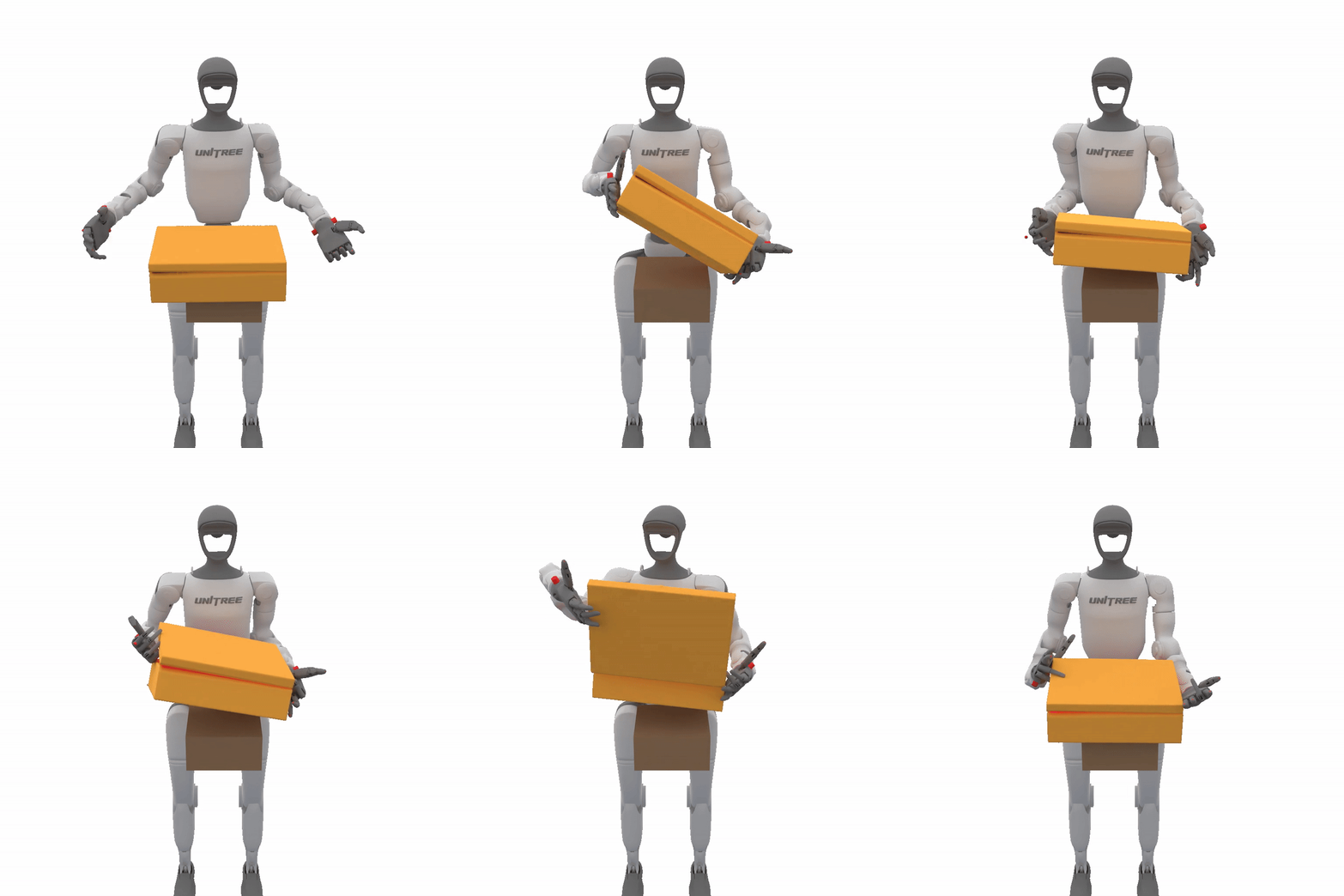
Bridging Generative Diffusion and Reinforcement Learning for Dexterous Robot Manipulation: Developed a framework for learning contact-rich manipulation by retargeting human-object interactions from the ARCTIC dataset to a humanoid robot using RL environments. To enhance generalizability beyond the dataset, we are integrating a text-conditioned Diffusion Transformer with IK-guidance and Critic-informed sampling, ensuring the generative model accounts for robot kinematics and task-success metrics. Stay tuned! |
|
Building a data engine for web-scale robot training. Stay tuned! |
|
Developed SkillGraph, an ontology-driven framework that unifies semantic knowledge representation with automated task planning to enable flexible multi-robot assembly. By bridging high-level reasoning with low-level control, the system dynamically maps abstract task goals into executable skill primitives, ensuring robust manipulation in complex environments. The SkillGraph comprises of multiple user-interfaces to interact with the system, one of which is a human-video demonstration —where the system is able to learn the skill from the human-video demonstration and then use it to plan and execute the task. |
|
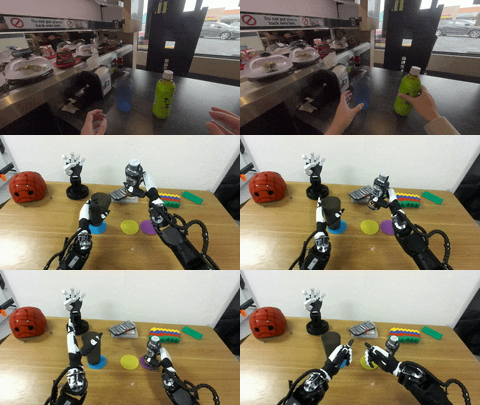
Jialong Li, Tairan He, Ge Yan, David J. Yoon, Ryan Hoque, Jian Zhang, Sha Yi, Guanya Shi, Xiaolong Wang Robot Data Workshop @ CoRL 2025 Developed HAT, an end-to-end policy that models human demonstrators as a distinct humanoid embodiment to enable scalable imitation learning. The framework utilizes a unified kinematic representation to directly map egocentric human video to robot actions, bypassing the need for complex intermediate affordance representations. This approach allows for efficient learning from diverse human demonstrations —significantly improving policy robustness and out-of-distribution generalization for bimanual manipulation. |

|
IROS 2024 We developed an unsupervised approach to learn temporal abstractions of skills incorporating agent-environment interactions. We hope to learn representations of patterns of motion of objects in the environment, or patterns of change of state. Our approach is able to learn semantically meaningful skill segments across robot and human demonstrations, despite being completely unsupervised. |

|
We developed an algorithmic framework to extract different intrinsic features from human demonstrations. We are studying various features, including interactions with objects along the trajectory, analyzing the environment for interactions with the background (e.g., wiping or writing), and classifying the type of motion within a trajectory segment (e.g., shaking, rotating, or transporting). |
|
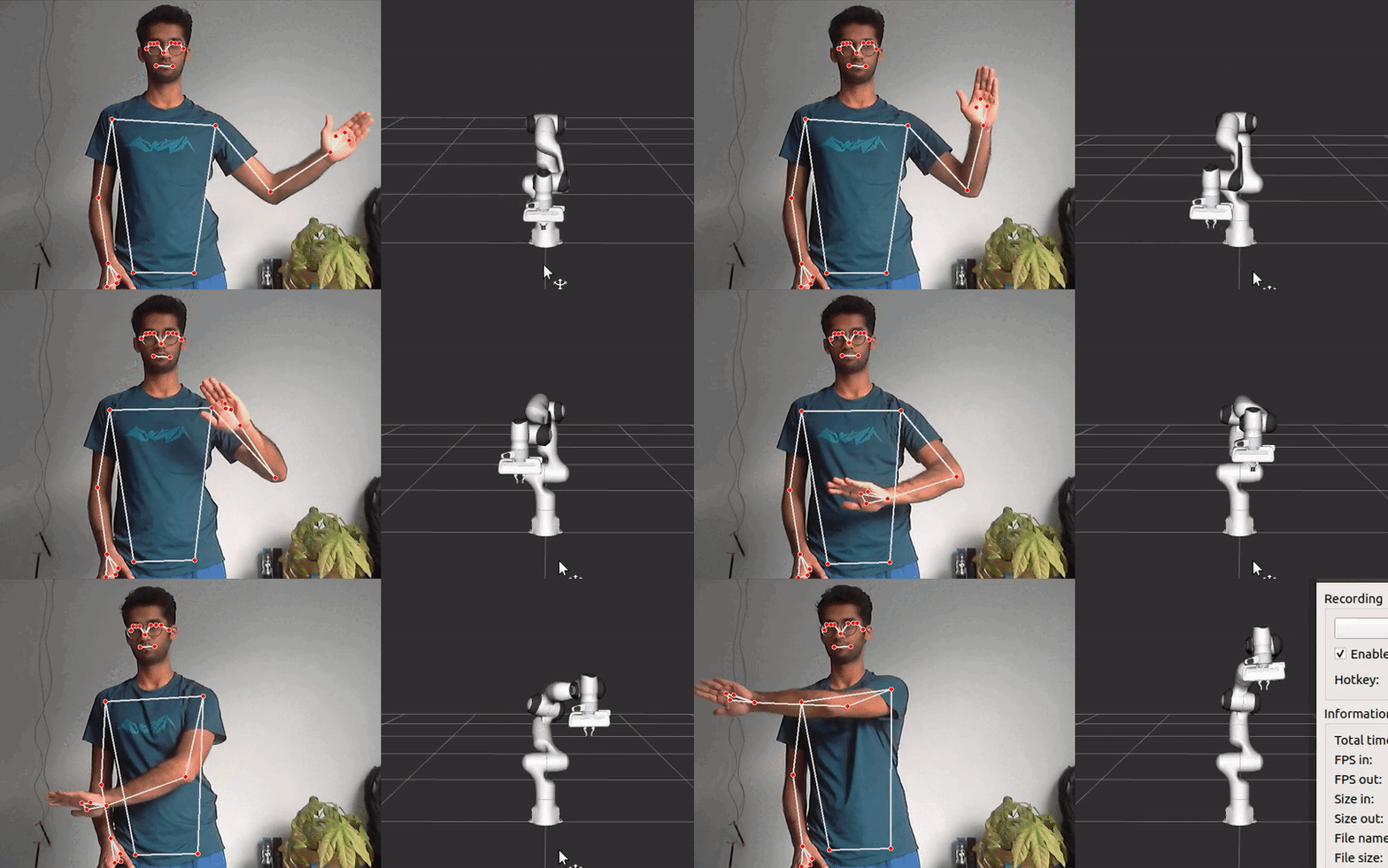
We presented a method to learn human motions using a Learning-From-Demonstration approach. Using Dynamic Motion Primitives, we were able to teleoperate a Franka Panda Arm using the learned trajectories. |
Projects
|
|
Multi-GPU SpeedUp with Custom-implementation in Needle Framework (DDP and ZeRO-3)
|
|
Comparing different methods including Autoencoders and PCA, for feature representation in face reconstruction
|
|
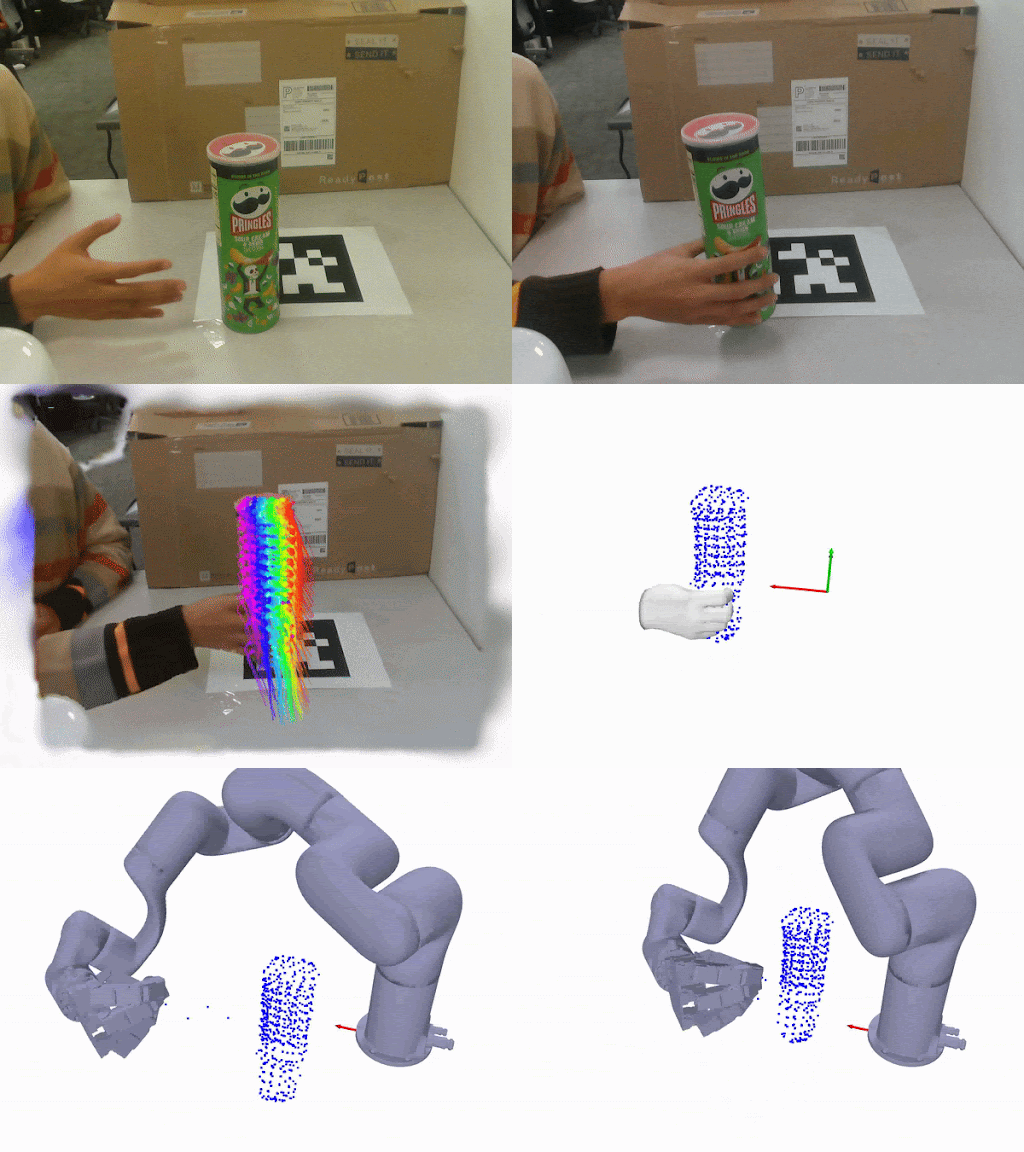
We proposed a pipeline to benchmark pre-training methods using different state representations.
Our method consisted of extracting sensorimotor information from videos by lifting the human hand and the manipulated object in a
shared 3D space in simulation (IsaacGym), i.e. either 3D point-tracks or 3D meshes.
Then, we retarget hand-trajectories to a Franka with a Shadow hand.
Finally, we fine-tune on various tasks.
|

|
Distributing candies during Halloween at the Robotics Institute, Carnegie Mellon University
|
Work Experience
Roboverse Reply GmBH
Robotics Engineer | July 2023 - April 2024
- Developed a perception pipeline for detecting and reporting measurements from analog gauges. Set up data-annotation, post-processing, and real-time inference of gauge measurements. Dockerized the application to integrate with Boston Dynamics' Spot to autonomously collect data in a factory environment.
- Developed and deployed a sludge-detection system based on Yolo-v8 to detect amount of sludge present in outdoor water-storage tanks. Achieved an accuracy of 95% by fine-tuning a trained RESNET backbone with custom data as well as data-augmentation to account for various lighting, time of the day, as well as adversarial objects.
- Created a webRTC pipeline using gRPC to transfer point cloud data from Spot's LIDAR sensor to Oculus VR Headset, enabling a remote user to observe Spot's immediate environment in real time.
- Migrated the company's robotic framework from ROS to ROS2.
Achievements
- German National Scholarship - Deutschland Stipendium (2021-2024)
- Heinrich and Lotte Muhlfenzl Scholarship - undergraduate research scholarship (2023)
- TUM PROMOS - merit scholarship for stay-abroad research (2023)
- Max Weber Program - nominated by the university (2022)
Reviewer
- Robotics and Automation Letters (RA-L)
- International Conference on Learning Representations (ICLR)
- Conference on Robot Learning (CoRL)
- International Conference on Intelligent Robots and Systems (IROS)
Teaching Assistant
- Introduction to Robot Learning (16-831), Carnegie Mellon University, 2025
- Robotic Control Laboratory (6-931), Technical University of Munich, 2023
- Mathematical Analysis (9-411), Technical University of Munich, 2022
|
Last updated: Jan 2023 |